




THIS IS
BAD VILBEL

OUR BAD VILBEL
Bad Vilbel is diversity!
Bordering Frankfurt to the south and the Wetterau region—characterized by its cultural and floodplain landscapes—to the north, this vibrant city combines a multitude of opportunities for local recreation and tourism.
The city’s geological location once led to its founding and rise. Today, the idyllic course of the partially renatured Nidda river provides a green ribbon for relaxation, discovery, and activity throughout the entire urban area. Sandstone uplifts favored the development of mineral and medicinal water springs, which still offer guests refreshing breaks along the green ribbon today—completely free of charge and completely healthy.
But that’s not all, water and geology are everything in Bad Vilbel: they make the landscape interesting and enable exciting hikes and bike tours through former quarries, biotopes, orchard meadows, forests, rivers, and floodplain landscapes. The cycling and hiking infrastructure has been excellently developed with clear markings on trails ranging from barrier-free paths to the challenging, certified Vilbelsteig. These are always accompanied by fascinating information, peaceful places to rest, and great views of the Taunus ridge, the Frankfurt skyline, and the fertile landscape of the Wetterau stretching as far as the Vogelsberg.
Nature and culture also merge here in the heritage-listed Kurpark, in the Kurgarten next to the modern VILCO congress center, in the Burgpark Arboretum, and of course with Hesse’s largest festival in the Wasserburg on the Nidda.
In addition, there are events and experience sites such as the open-air cinema, the Alte Mühle cultural center, the Springs Festival, the Bad Vilbel Market, the local history museum in Massenheim, the Roman Mosaic, and the Fountain and Bath Museum. For sports, fun, and health, in addition to the cycling and hiking trails, there are Kneipp facilities, the Aqua Park, and the sports complex—all in the Burgpark—as well as the multi-generational facilities in the Gerberpark, the outdoor pool in summer, and a golf course in Dortelweil.
And after all that movement and activity, urban life follows: the lively city center offers shopping and diverse gastronomy in and around Frankfurter Straße and the modern city center area of Niddaplatz, the Library Bridge, and Günther-Biwer-Platz.
With around 36,000 inhabitants, the city of Bad Vilbel is the largest city in the Hessian district of Wetterau. In addition to the core city, it consists of the four districts of Heilsberg (established in 1948), Gronau (incorporated in 1971), Dortelweil, and Massenheim (both incorporated in 1972).
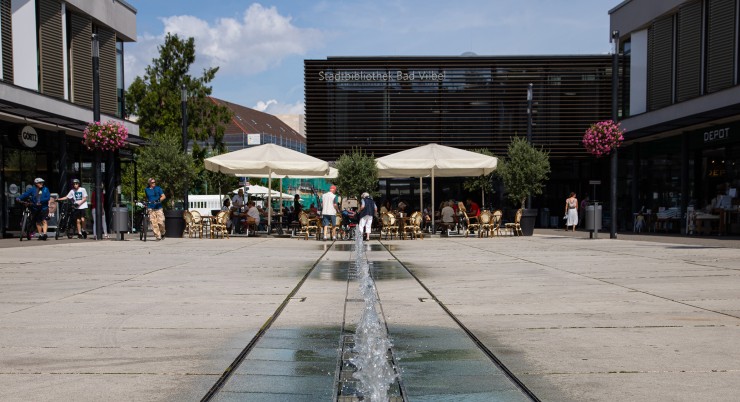
Bad Vilbel, the city of fountains and mineral springs, is a vibrant, diverse city. Its modern center offers pleasant shopping opportunities with space to stroll, as well as a wide range of cultural, leisure, and recreational activities.
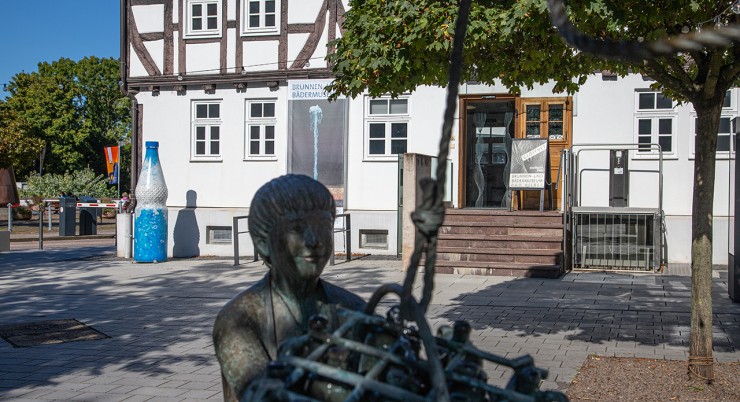
The museum showcases the history of Bad Vilbel’s medicinal and mineral water with fascinating exhibits as well as touchscreen and screen presentations. Alongside a journey through the history of the spa and fountain operations, it also explores bottling technology over time and the development of packaging, including the pros and cons of reusable and single-use bottles.
Water runs through the town, water runs through the town’s history, and water is still ever-present today.

A mill has likely stood here since the year 830. Damaged multiple times and partially collapsed due to flooding, it was abandoned as a grain mill in 1950.
Revived by the city as a cultural center in 1984, it has become a true landmark.
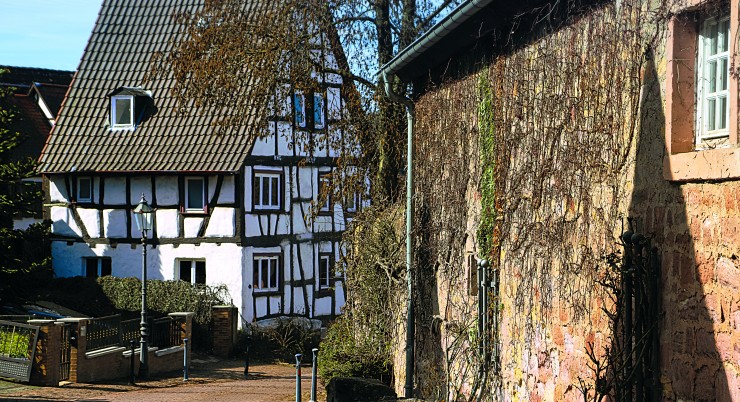
The market square with the Old Town Hall and the Fountain Museum forms Bad Vilbel’s historic centre; the Town Hall Bridge is even the birthplace of the town. After all, old trade routes crossed here; travellers had to ford the River Nidda, and the tolls provided a good living.

Four park areas line up along the Nidda, uniting to form a green belt through the entire city. The individual areas could hardly be more diverse, which is precisely what makes a visit and a stroll so interesting.
The Spring Museum is located on the company premises of Hassia Mineral Springs (Gießener Straße) and can be visited as part of a guided factory tour.


